If you are asking about Death as yes or no, the shortest answer is: usually maybe, but strongly tied to transformation.
The Death card rarely gives a clean, effortless yes. It also does not always mean a hard no. More often, it says that the current version of the situation must end before a real answer can appear. In other words, the card is less interested in giving you permission and more interested in showing you what has to change.
That is why Death can feel intense in a yes-or-no reading. It is not here to scare you. It is here to tell you that something old is closing, and that your answer depends on whether you are ready to release what no longer fits.
This article is for readers who want a practical answer, not a vague one. You will learn:
- what Death as yes or no means in plain English
- how upright and reversed Death change the answer
- what the card means in love, career, and personal decisions
- how to tell whether Death leans yes, no, or maybe in your specific question
TL;DR
- Death as yes or no is most often a maybe
- Upright Death usually means change is necessary and can lead to a better path
- Reversed Death often points to resistance, delay, or refusal to let go
- In love, the card often signals the end of an old pattern before a healthier dynamic can begin
- In career or personal growth, Death can be a powerful yes to transformation but a no to staying the same
- The card does not usually mean literal death
What Does Death as Yes or No Mean?
Death as yes or no means the answer is not simple because the situation is changing shape.
That is the most important idea to understand. Some tarot cards answer like a green light. Others answer like a red light. Death answers more like a doorway: one chapter is ending, and the next one has not fully opened yet. If you are asking the right question, this card can absolutely move you toward a yes. But if you are asking whether things can stay exactly as they are, Death often behaves like a no.
So the real message is:
- yes, if you are ready for a transition
- no, if you want the old pattern to remain untouched
- maybe, if the ending has started but the new cycle is not fully visible yet
This is what makes the death tarot meaning so powerful in yes-or-no readings. The card is not passive. It pushes movement. It closes what is exhausted. It removes what cannot grow with you. And then it creates space for something more honest.
Does the Death Card Mean Literal Death?
For most tarot readings, no, the Death card does not mean literal death.
This is one of the biggest reasons people feel nervous when they pull it. The name sounds dramatic, but the actual death card meaning is usually about endings, transition, release, and rebirth. A relationship dynamic may end. A job identity may end. A way of thinking may end. A version of you may end. But the point of the card is transformation, not doom.
That matters even more when you are interpreting death as yes or no. Fear can make you read the card too literally and miss its actual wisdom. Death is saying, "Something is over." It is not necessarily saying, "Something terrible is about to happen."
If you remember one line from this article, let it be this:
Death is not a punishment card. It is a transformation card.
Death Upright as Yes or No
When Death appears upright, the answer is usually maybe leaning yes, but only through change.
Upright Death says the old structure is no longer sustainable. That can feel uncomfortable at first, but it is often a healthy sign. The card is telling you that the future answer depends on whether you are willing to step into a new cycle.
In practical terms, upright Death often means:
- yes to leaving behind what is dead weight
- yes to a necessary ending
- yes to a fresh chapter
- no to repeating the same pattern
- maybe while the transition is still unfolding
If your question is about growth, healing, reinvention, or finally moving on, upright Death can be a very strong signal. If your question is about keeping an old dynamic alive even though it has already outgrown itself, the card becomes much less supportive.
A useful shortcut: Upright Death is often a yes to evolution and a no to stagnation.
Death Reversed as Yes or No
Death reversed meaning in a yes-or-no reading is usually no or maybe delayed.
Reversed Death often points to fear of change, clinging, emotional backlog, or hesitation to close a chapter that clearly needs closure. Instead of transformation flowing naturally, the process gets stuck. The answer is not blocked because the future is impossible. It is blocked because someone is resisting the transition.
That is why reversed Death may sound like:
- no, not in the current state
- maybe, but only after release
- no, if the question depends on denial
- not yet, because something unresolved is still being carried forward
If upright Death says, "The ending is happening," reversed Death says, "The ending should happen, but someone is fighting it."
This distinction is crucial. In a real reading, the upright card often feels clean even when it is intense. The reversed card often feels heavy because the energy is stuck.
Death as Yes or No in Love
In love, death as yes or no almost always points to transformation before clarity.

That can mean several different things:
- a relationship is ready to deepen by shedding an immature pattern
- a fading connection is nearing its natural ending
- an old heartbreak still needs to be released before new love can begin
- the relationship cannot continue in the same form
So is Death a yes or no for love? Usually:
- yes, if both people are ready to change honestly
- no, if the relationship depends on pretending nothing is wrong
- maybe, if the bond is in a transition phase and not stable yet
This is where death in love becomes more useful than a simple yes-or-no label. The card is often less about romance disappearing and more about the old emotional structure dying. If that structure was unhealthy, this can actually be good news.
If You Are Asking About Reconciliation
Death tends to be strict about reconciliation. It is rarely a "yes, just go back and do the same thing again."
Instead, it asks:
- has the old cycle truly ended?
- has anyone genuinely changed?
- are you returning to love, or to familiarity?
If the answer is real transformation, Death may support a new beginning. If the answer is repetition, the card leans no.
If You Are Asking About Someone's Feelings
Death as feelings often describes emotional intensity, distance from an old self, or a strong inner shift. Someone may be trying to let go, trying to change, or realizing that their feelings cannot stay in the same form.
That does not always mean the feeling is gone. It often means the feeling is changing.
If You Are Asking About Someone's Intentions
Death as intentions usually points to a desire to transform the situation. Sometimes that means deepening the bond through honesty. Sometimes it means ending something that no longer feels aligned.
The key is that the person is not looking for a superficial fix. They want something real to change.
Death as Yes or No in Career
In career readings, Death can be surprisingly productive.

If you are asking whether to leave a draining role, pivot direction, stop forcing a dead-end plan, or release a professional identity that no longer fits, Death may be a clear yes. If you are asking whether you can stay in the same stagnant situation and somehow get a different result, the card often says no.
This makes death career meaning very direct:
- yes to transition
- yes to reinvention
- yes to closing an old chapter
- no to clinging to what has already ended in spirit
If your question is "Should I take this opportunity?" Death becomes more positive when the opportunity helps you evolve. It becomes more cautionary when the opportunity is just a new costume for an old problem.
Death as Yes or No in Personal Decisions
For everyday decisions, Death asks one core question:
What are you being asked to release?
That is why the card can be so useful in decision-making. It does not just tell you whether something will work. It tells you what the decision requires from you.
Here is a quick framework:
| Question Type | Likely Answer | Why |
|---|---|---|
| Starting over after a painful ending | Maybe leaning yes | A new cycle is possible, but only after closure |
| Staying in a situation that has clearly expired | No | Death rejects stale structures |
| Making a brave, honest life change | Yes | The card supports necessary transformation |
| Going back to an unchanged past dynamic | No or maybe delayed | Repetition blocks growth |
| Asking for instant certainty during a messy transition | Maybe | The change is real, but the full result is still forming |
This is where death advice becomes very practical. The card says: do not ask only what you will get. Ask what must end first.
When Death Leans Yes
Death often leans yes when:
- you are releasing an old identity
- you are ending a cycle that is already complete
- you are choosing honesty over denial
- you are making room for something more aligned
- the question involves healing, growth, or reinvention
In these cases, the answer may still feel intense, but the direction is constructive.
When Death Leans No
Death often leans no when:
- you want things to stay exactly the same
- you are avoiding an obvious ending
- the question is rooted in fear or clinging
- the connection or situation has already run its course
- you are hoping for renewal without change
This is why the card can feel sharp. It does not support emotional procrastination.
When Death Is Truly a Maybe
Death is most honestly a maybe when the ending is clear but the rebirth is not fully visible yet.
This is common in:
- breakups that are still emotionally active
- career transitions without a final next step
- situations where one person is ready to change and the other is not
- personal healing periods where the old self is fading but the new self is still forming
In this stage, death outcome is not blank. It is simply unfinished.
How to Read Death in a Yes-or-No Spread
If you want to read death as yes or no more accurately, use this three-step filter:

1. Ask What Is Ending
Before deciding yes or no, identify what the card is closing. Is it a relationship pattern? A job identity? A fear-based choice? Death always has an ending attached to it.
2. Ask Whether Change Is Welcome or Resisted
If the energy around the question welcomes change, the card becomes more supportive. If the energy resists change, the card becomes more difficult.
3. Ask Whether the Question Is About Growth or Preservation
Death likes growth questions. It is much less generous with preservation questions.
For example:
- "Should I finally move on?" often gets a more open answer
- "Can I keep this fading situation exactly as it is?" usually does not
This is the difference between using tarot as a shortcut and using it as insight. Death gives insight first.
A Better Way to Ask the Question
Sometimes the problem is not the card. It is the question.
Instead of asking:
- "Is this a yes or no?"
Try asking:
- "What has to end for this to work?"
- "What am I refusing to release?"
- "Is this transition leading me somewhere healthier?"
- "Am I trying to revive something that has already completed its lesson?"
These questions work especially well with Tarova because the experience is designed to help you turn a vague emotional swirl into a clear, answerable question. Instead of jumping straight to a random yes or no, you can move through guided prompts, a ritual-like shuffle, cut, and draw flow, and a structured interpretation that helps you see the real pattern underneath the card.
If your question is emotionally loaded, that process matters. It helps you move from fear to clarity.
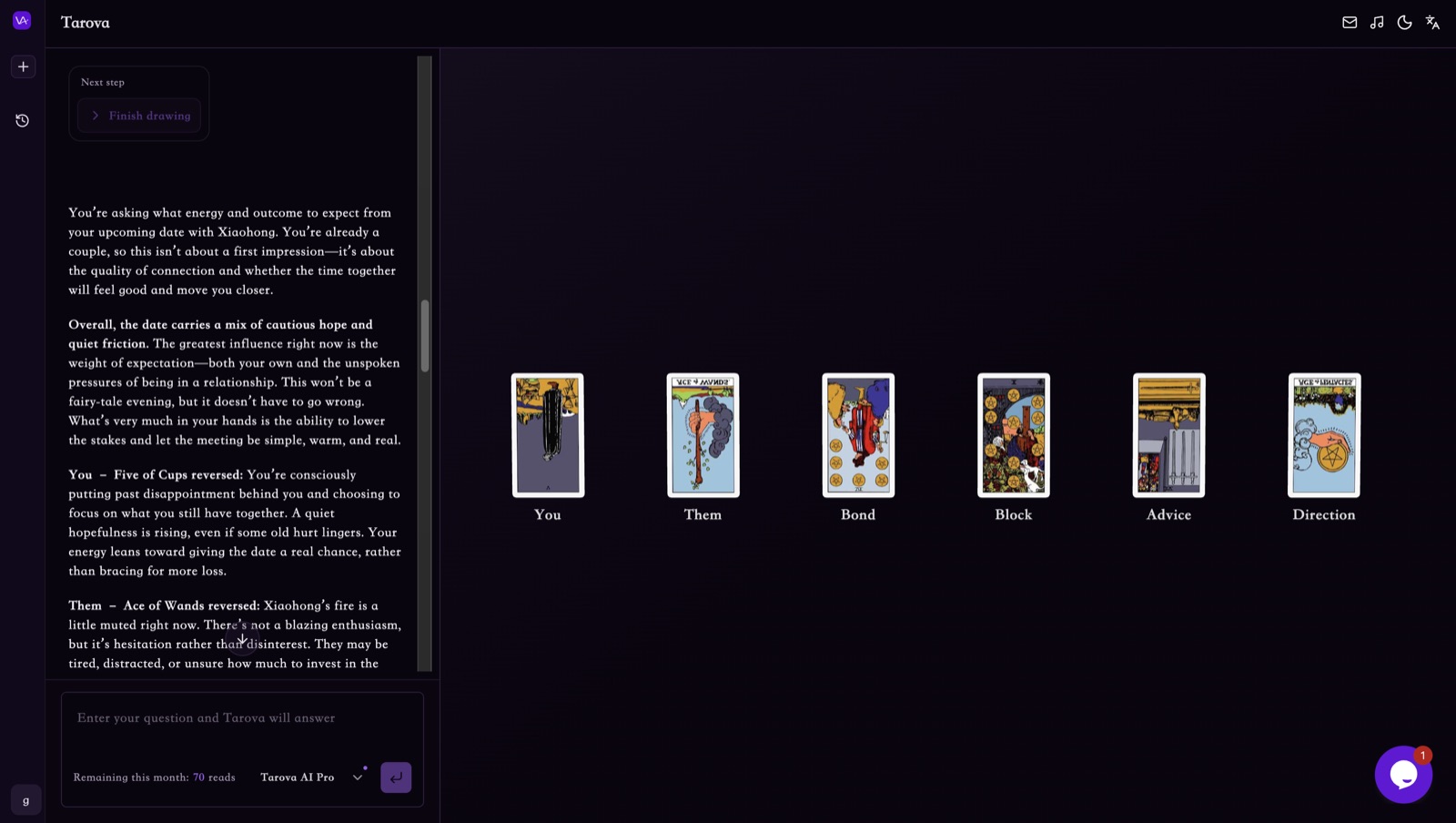
If that kind of process feels more useful than a generic verdict, you can continue with Tarova chat, explore showcases, or review the full experience at pricing.
FAQ
Is Death as yes or no a yes?
Usually not a simple yes. Death is more often a maybe or a yes through transformation. If the situation requires you to release an old pattern and move into a healthier cycle, the card can lean yes.
Is Death as yes or no a no?
It can be. Death often acts like a no when the question depends on keeping things exactly the same, avoiding closure, or returning to a situation that has already ended emotionally.
What does Death reversed mean in a yes-or-no reading?
Death reversed meaning usually points to delay, resistance, fear of change, or unfinished endings. In yes-or-no readings, that often becomes a no or a maybe-until-you-let-go.
Is the Death card bad?
Not usually. Death feels intense because it brings endings, but endings are not automatically negative. Many readings show Death as a necessary turning point that makes healthier growth possible.
Does the Death card mean a breakup?
Sometimes, but not always. In love readings, it more often means that the current emotional pattern cannot continue as it is. That can lead to a breakup, a breakthrough, or a serious reset.
Final Thoughts on Death as Yes or No
If you are asking about death as yes or no, do not reduce the card to a flat answer too quickly.
Death is one of the clearest cards in tarot, but it speaks in the language of endings and rebirth. It says that the old chapter is closing. It says the truth can no longer be avoided. And it says that your answer depends on whether you are willing to move with the transformation or fight it.
So the most honest summary is this:
- yes, when you are ready to evolve
- no, when you are trying to preserve what is already over
- maybe, when the ending is real but the next chapter is still forming
If you want a more personal answer than a generic keyword article can give, try a guided reading on Tarova's AI tarot experience. It is built to help you clarify your question, move through a more immersive shuffle-cut-draw flow, and receive structured insights you can actually use.