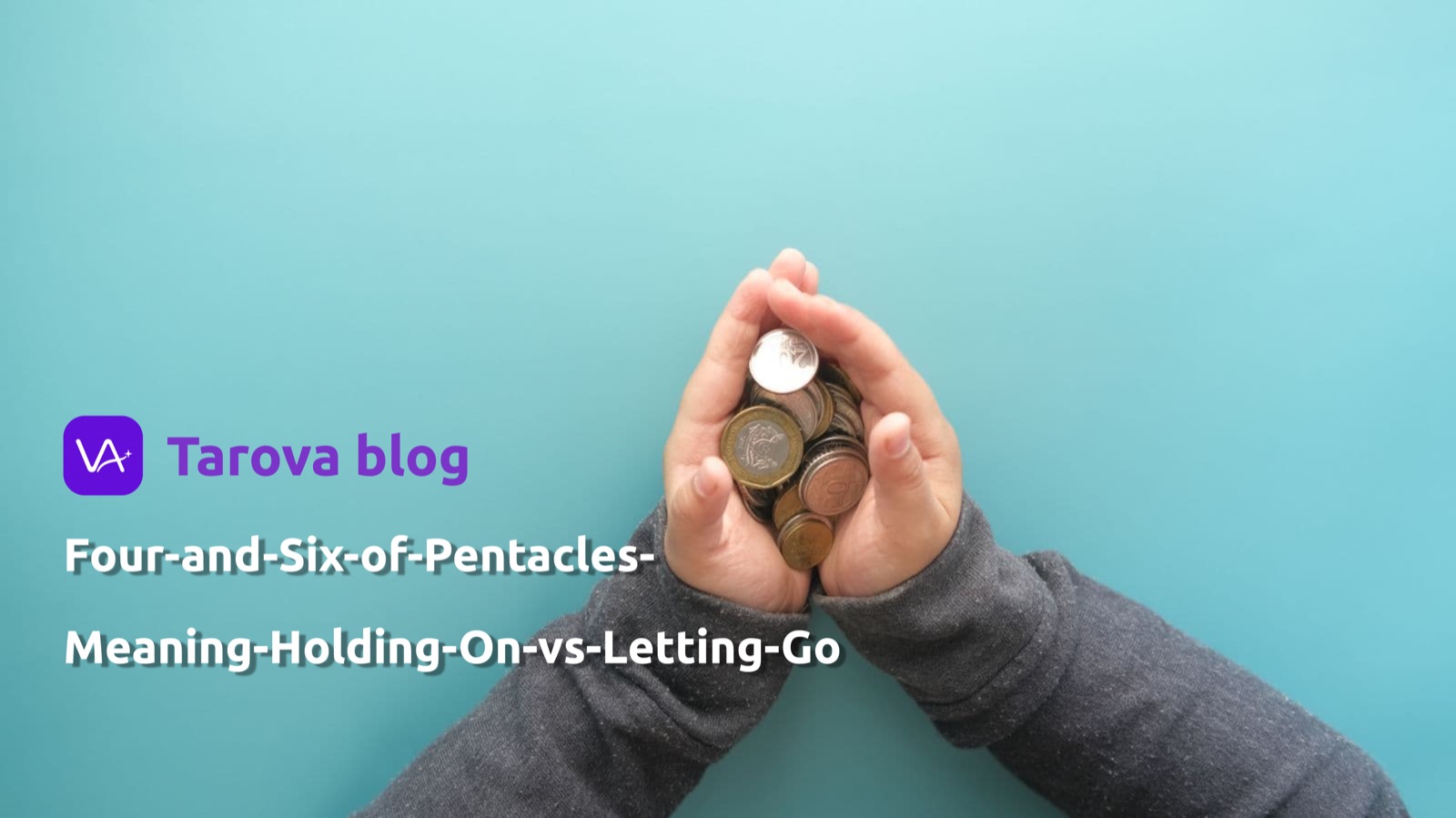
Why These Two Cards Show Up Together
You pull the Four of Pentacles, then the Six. Two pentacles cards, side by side, and they seem to argue. One is a hand clenched around a coin. The other is a hand giving coins away. On paper they contradict. In a real reading, they rarely do. They're describing a conversation you're already having inside: how much of what you have belongs to you, and how much you're supposed to share.
This is one of the most common pairings for money questions, and for love questions that have nothing to do with cash. When the two appear together, the reading usually isn't about the money at all. It's about what money stands for in your life: safety, worth, control.
What the Four of Pentacles Brings: The Grip
The Four of Pentacles is the card of holding on. It shows someone clutching a coin, seated inside a fortress of their own resources. It's the savings account you don't touch, the boundary you don't let anyone cross, the part of yourself you keep behind a wall.
There's nothing automatically wrong with this. Holding on is how you survive a hard year, how you say no after being taken advantage of, how you keep a promise to yourself. It only becomes a problem when the grip tightens past safety and into fear — when you stop checking whether what you're protecting is real or just familiar.

What the Six of Pentacles Brings: The Give
The Six of Pentacles is the card of generosity, and it's more honest than it looks. In the classic image, one person gives while another receives. Most readers read this as charity, kindness, help flowing in the right direction.
But a second meaning matters just as much here: reciprocity. The Six is about fair exchange — giving when you have, receiving when you don't. It asks you to be honest about what you give and what you accept, and whether the balance in your life actually exists or just looks like it from the outside.

The Real Question This Combination Is Asking
Put the two together and you get the tension most money and relationship advice fails to solve: where is your self-worth actually coming from?
If the Four dominates, you may be using control as a substitute for safety — holding onto money, people, or plans because letting go feels like a fall. If the Six dominates, you may be giving to feel valuable, mistaking generosity for worth.
Most people who pull these two cards together fall into one of three situations.
Hoarding While Telling Yourself You're Secure
You've got the savings, the plan, the emergency fund. But you can't relax. You check balances more than you check in with yourself, and say no to things you could afford because saying yes feels risky. The Six is asking: what would you lose by letting a little of it flow? Not all of it — a little.
Giving Until You Disappear
The other direction is just as common. You're the one who always pays, always helps, always smooths things over. It feels generous. It might be. But if you can't receive — a compliment, a favor, a dollar — the Six is one-sided, and this pairing keeps showing up until the ledger balances. The Four is your invitation to set a boundary and keep some of it for yourself.
Unequal in a Relationship
In love, these two cards almost always point at the same sore spot: one partner gives more than the other, or one withholds more than the other. It rarely shows up as dramatic conflict. It shows up as the quiet resentment you feel at the end of a month — the "I always..." and "you never..." neither of you says out loud. Here the cards stop being about money. They're about emotional capital: time, attention, who initiates, who keeps the relationship open.
When Both Are Reversed
The reversed versions change the texture but not the theme. Reversed Four of Pentacles is a hand finally unclenching — money moving, walls coming down, sometimes spending or giving too much too fast because the grip gave out. Reversed Six of Pentacles is generosity with strings attached, or giving that leaves you empty because it was never truly reciprocal.
Draw the reversed pair together and the message is the same as the upright one, only louder: your money or giving habits are out of balance, and you already know which way the scale tips.
A Yes or No? Maybe, and Here's Why
Ask most readers whether this pairing is a yes or a no and the honest answer is "maybe." Not because the cards are vague, but because the question this combination asks isn't the question you asked. A yes/no answer misses the point. The cards aren't telling you a decision is coming — they're telling you a balance needs finding. The better question isn't "should I give?" It's "what am I protecting, and is it still protecting me?"
Working With the Combination
Some practical ways to take this reading somewhere:
- Set a giving number in advance, so generosity becomes a choice instead of a reflex. Decide before you're in the moment.
- Practice receiving something small and letting it land. Say thank you, and stop there.
- Name the boundary you hold out of fear, and the one you hold out of self-respect. Keep the second one.
- Ask what you're actually afraid will happen if you loosen the grip. Write it down. Most of the time the answer is a feeling, not an event.
You can take these questions into a structured reading — pull these two cards, name a specific relationship or money habit, and let the session walk you through where the grip is and where the give is. That's exactly what the chat-based reading is built for [https://tarova.ai/chat], and the showcase section has real walkthroughs of spreads like this [https://tarova.ai/showcases].
FAQ
Is four and six of pentacles a good combination for money?
A balanced one, not a jackpot one. It isn't predicting a windfall; it's describing how you relate to the money you have. In practice it lands well in a money reading, because it pushes you to get your giving and holding in line — the foundation of a stable money life.
Do four of pentacles and six of pentacles conflict?
They look like they do — one holds, one gives — but they're two ends of the same spectrum. Conflict only shows up when you're stuck at one end. If you're exclusively hoarding or exclusively giving, the cards feel like they're fighting. The combination is the fight, and the resolution is the point.
What does four and six of pentacles mean in love?
It usually points to an imbalance in how two people give and receive — time, attention, emotional effort, not just money. One partner holds back while the other gives too much, or both hold back waiting for the other to move first.
What does it mean when both cards are reversed?
Usually that the imbalance has gotten obvious. Reversed Four is money or boundaries loosening, often too fast. Reversed Six is generosity with strings attached, or giving that leaves you drained. Together they're a nudge to rebuild the balance deliberately instead of waiting for it to correct itself.