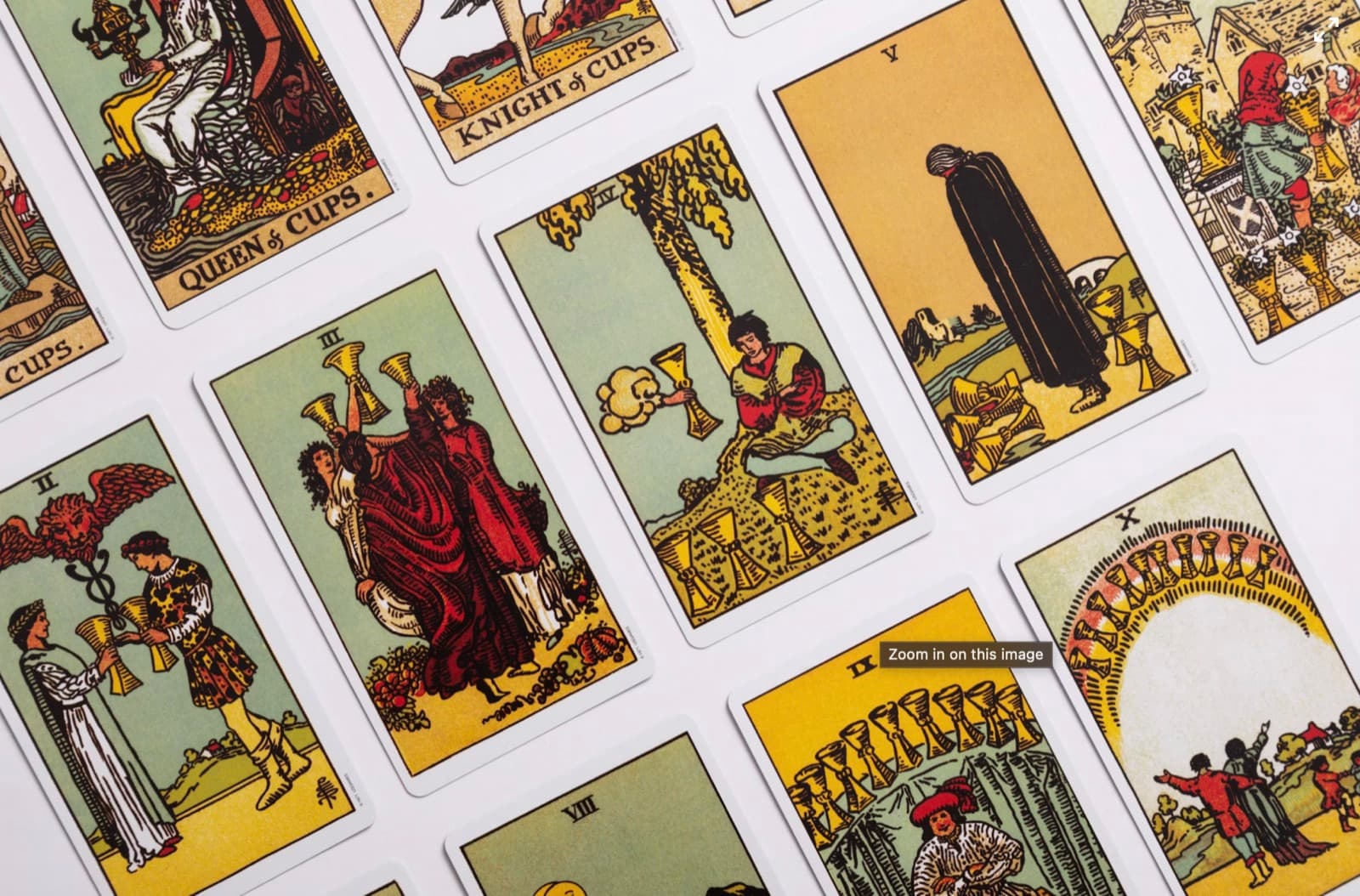
If you've ever searched for the meaning of a tarot card, you've probably seen hundreds of websites offering quick interpretations.
The Fool means new beginnings.
The Tower means sudden change.
The Lovers represents relationships.
While these definitions are helpful starting points, they only tell part of the story.
Tarot was never designed to be read as a collection of isolated card meanings.
A card's message changes depending on:
- The question being asked
- The position of the card
- The surrounding cards
- The reader's interpretation
- The context of the person's life
That's why two people can draw the same card and receive completely different insights.
In this guide, we'll explore how tarot card meanings actually work, why context matters, and how modern AI tarot readings can help uncover deeper interpretations.
What Are Tarot Card Meanings?
Every tarot card contains a collection of symbols, themes, and archetypes.
These symbols act as a language.
Rather than delivering fixed answers, tarot cards provide symbolic messages that encourage reflection and self-exploration.
For example:
The Fool
Common themes:
- New beginnings
- Curiosity
- Taking risks
- Trusting the journey
But in one reading, The Fool may encourage a bold career move.
In another, it may warn against acting impulsively.
The meaning depends on context.
This is true for every card in the deck.
Understanding the Structure of Tarot Cards
The traditional tarot deck contains 78 cards divided into two major groups.
Major Arcana
The 22 Major Arcana cards represent significant life lessons and transformative experiences.
Examples include:
- The Fool
- The Magician
- The High Priestess
- The Hermit
- The Star
- The World
These cards often appear when a reading involves deeper personal growth or important life transitions.
Minor Arcana
The remaining 56 cards reflect everyday experiences and practical situations.
They are divided into four suits:
Cups
Associated with:
- Emotions
- Relationships
- Intuition
Wands
Associated with:
- Passion
- Creativity
- Action
Swords
Associated with:
- Thoughts
- Decisions
- Conflict
Pentacles
Associated with:
- Money
- Career
- Material life
Understanding these foundations makes it easier to interpret individual cards within a larger reading.
Why Tarot Card Meanings Change in Different Readings
One of the biggest misconceptions about tarot is that every card has a single meaning.
In reality, tarot works more like a conversation than a dictionary.
Consider The Tower.
A traditional definition might include:
- Disruption
- Sudden change
- Collapse of old structures
But the message can vary dramatically.
For someone leaving a toxic relationship, The Tower may represent liberation.
For someone resisting necessary change, it may represent a warning.
For someone starting a new chapter in life, it may symbolize transformation.
The card remains the same.
The interpretation changes.
The Importance of Tarot Spreads
Cards rarely appear alone.
Most readings use spreads that assign meaning to specific positions.
A simple three-card spread might represent:
- Past
- Present
- Future
Or:
- Situation
- Challenge
- Advice
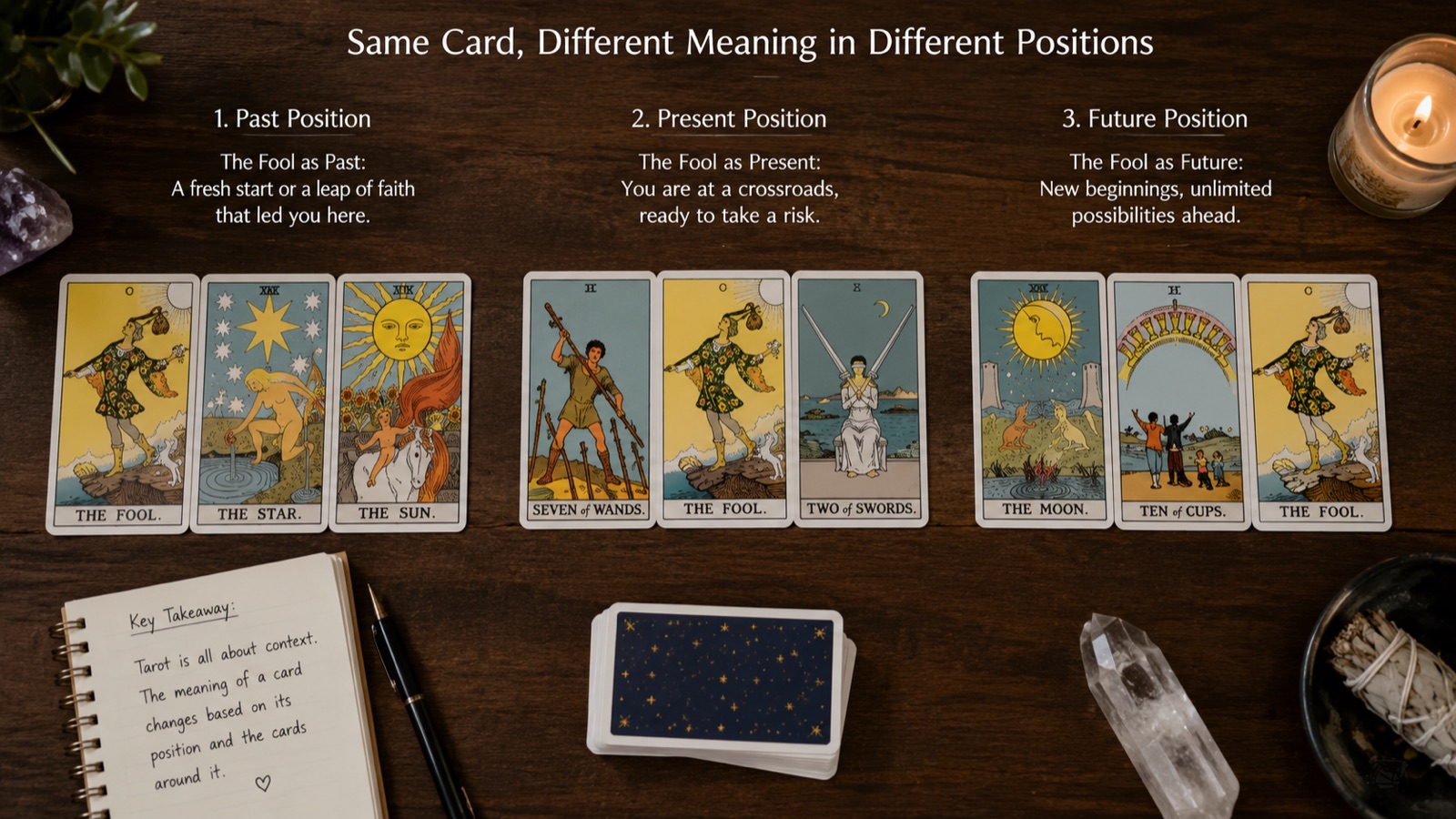
In these spreads, the position of the card is just as important as the card itself.
For example:
Drawing The Hermit in an Advice position carries a different message than drawing The Hermit in a Future position.
This is why experienced readers look at the entire spread rather than individual cards.
Common Tarot Cards and Their Core Meanings
While context always matters, understanding the core symbolism of popular cards provides a useful foundation.
The Fool
Keywords:
- New beginnings
- Adventure
- Possibility
The Magician
Keywords:
- Manifestation
- Skill
- Personal power
The High Priestess
Keywords:
- Intuition
- Inner wisdom
- Hidden knowledge
The Lovers
Keywords:
- Relationships
- Choices
- Alignment
The Hermit
Keywords:
- Reflection
- Solitude
- Inner guidance
The Star
Keywords:
- Hope
- Healing
- Renewal
The World
Keywords:
- Completion
- Achievement
- Fulfillment
These meanings are starting points, not final answers.
Why Static Tarot Meanings Are Often Not Enough
Many websites provide tarot interpretations as fixed definitions.
The problem is that life isn't fixed.
Imagine drawing:
- The Star
- The Moon
- The Hermit
The meaning of each card depends on how they interact.
The cards create a narrative.
Reading them separately can miss the deeper message entirely.
This is one reason many people struggle when using tarot reference guides alone.
Knowing card meanings is valuable.
Understanding how they work together is where real insight begins.
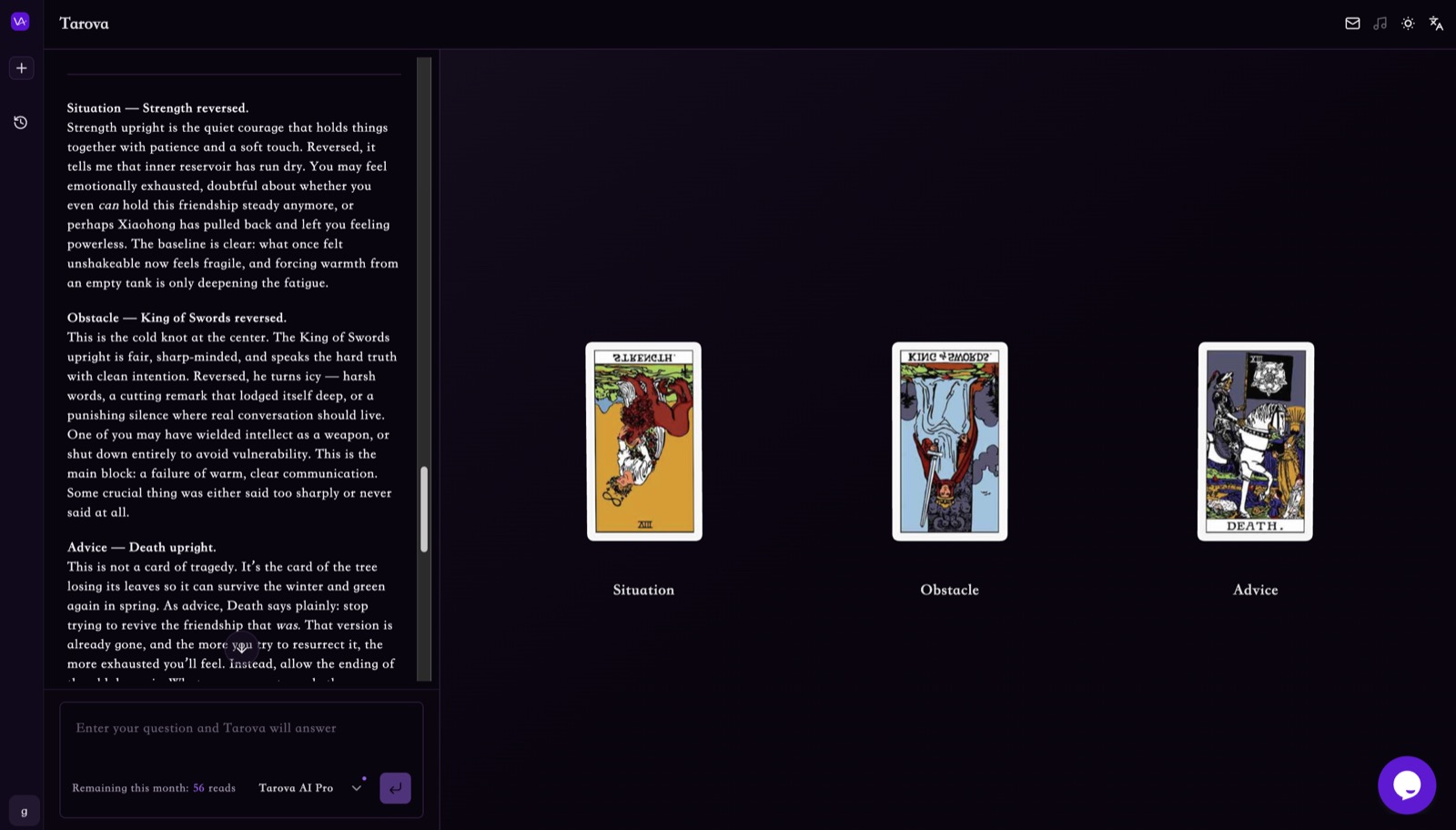
How AI Can Help Interpret Tarot Card Meanings
Modern AI Tarot systems go beyond simple card definitions.
Instead of showing a static meaning, AI can evaluate:
- Your question
- Your spread
- Card relationships
- Recurring themes
- Emotional context
This allows the interpretation to adapt to your situation.
Rather than asking:
"What does The Hermit mean?"
A better question becomes:
"What does The Hermit mean in this reading, for this situation, at this moment?"
That distinction creates a much richer experience.
Tarot Card Meanings in Context: A Better Way to Read Tarot
The most meaningful tarot readings don't come from memorizing 78 definitions.
They come from understanding the conversation between:
- The question
- The cards
- The spread
- The reader
- The situation
This is why experienced tarot practitioners focus on interpretation rather than simple card descriptions.
The cards provide symbols.
The meaning emerges through context.
Explore Tarot Card Meanings Through Interactive Readings
At Tarova, we believe tarot is most powerful when card meanings are explored within the context of a real question.
Instead of simply displaying predefined definitions, our AI-guided readings help you:
- Clarify your question
- Draw cards through an immersive ritual experience
- Understand card relationships
- Receive personalized interpretations
- Continue the conversation through follow-up questions
Because tarot card meanings are rarely about a single card.
They're about the story the cards are telling together.
Final Thoughts
Learning tarot card meanings is an important first step, but understanding tarot goes beyond memorizing definitions.
The most valuable insights often emerge when symbols, questions, and personal experiences come together.
Whether you're exploring tarot for the first time or deepening an existing practice, remember that the cards are not simply giving answers. They are offering a new perspective from which to view your situation.
And sometimes, a different perspective is exactly what we need.