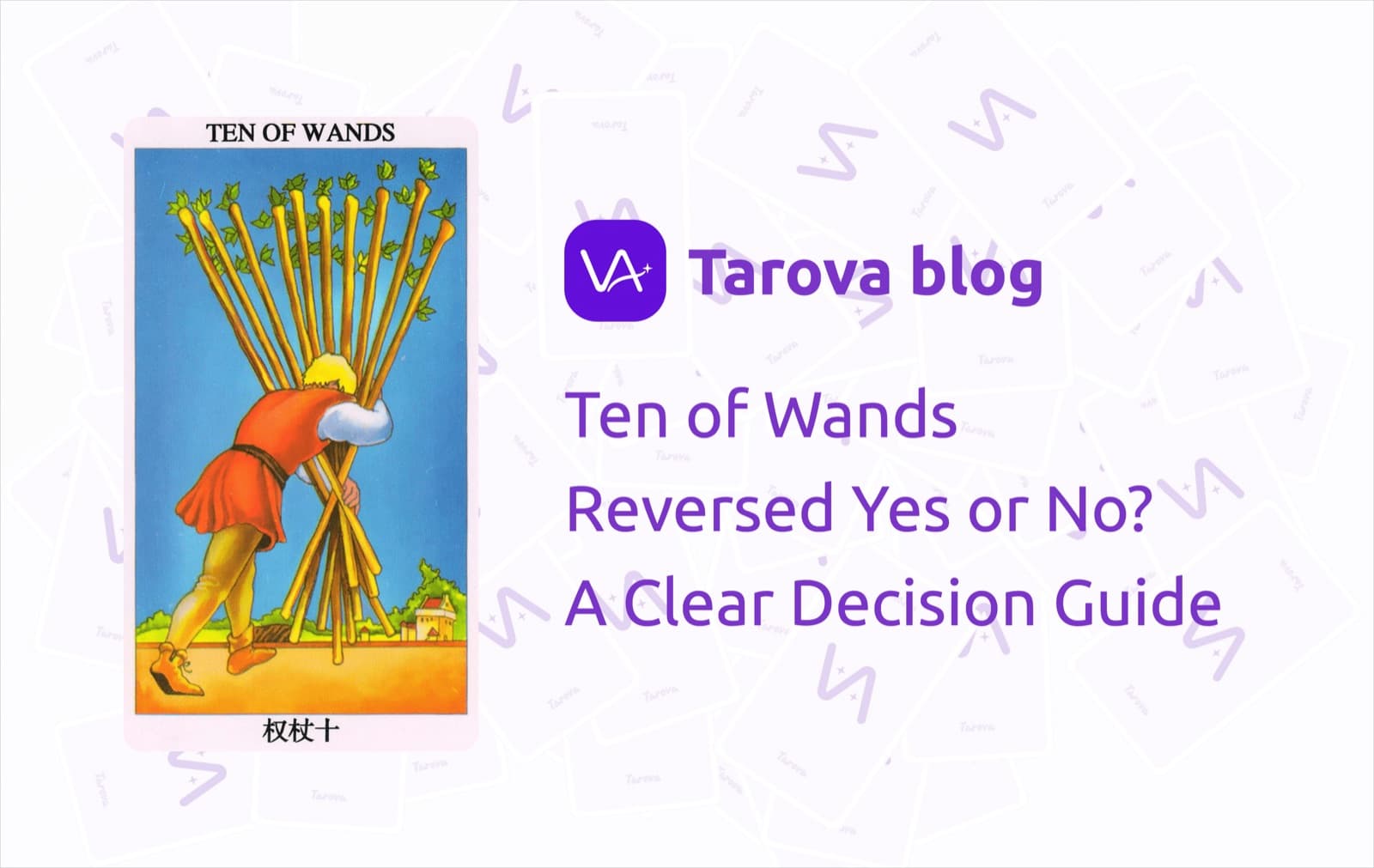
If you searched ten of wands reversed yes or no, you are probably not looking for a poetic answer. You want a decision to feel less foggy.
Here is the direct answer you can use as a baseline:
In a yes-or-no tarot reading, the Ten of Wands reversed is usually a NO, or a “not like this.”
It can become a conditional YES only if your question includes a real change: dropping the extra load, simplifying the plan, setting boundaries, or getting help.
This article is for anyone who pulled the Ten of Wands reversed and needs a quick, grounded way to interpret it in love, career, and decision readings without turning tarot into a reassurance loop.
Key takeaways (save this)
- Ten of Wands reversed usually says No to “more pressure,” “more responsibility,” or “push harder.”
- It can say Yes to “releasing,” “delegating,” “ending overcommitment,” or “choosing the lighter version.”
- If your yes/no question is too broad, the reversal often means: the question needs a better frame, not another card.
- Use one clarifier card only after you name what you are willing to stop carrying.
Quick answer: Ten of Wands reversed yes or no
If you want the simplest rule:
- Default answer: No
- Conditional answer: Yes, if you lighten the load
Think of the Ten of Wands as “I’m carrying too much.” Reversed, it’s not magically “all good.” It’s more like: “Something has to be put down, or this won’t work.”
If you are doing a strict one-card yes/no reading, keep it strict:
Ten of Wands reversed = Not sustainable.
What the Ten of Wands reversed means in plain English
The upright Ten of Wands is the classic overload card: too many responsibilities, too many obligations, too much “I’ll handle it.” Tarot.com’s Ten of Wands page frames the core theme as overwhelm and burnout, and gives an explicit NO for yes/no readings in the upright position.
Source: https://www.tarot.com/tarot/cards/ten-of-wands
When the card is reversed, it often points to one of these situations:
- Release is possible (but you have to choose it). You’re close to putting things down, delegating, or changing the plan.
- Martyr mode is running the show. You’re carrying extra weight to prove worth, loyalty, or love.
- Avoidance is masquerading as freedom. You’re exhausted and tempted to drop everything without a plan (which creates a different kind of burden later).
So the reversal isn’t “better.” It is a pivot point.
A simple decision table (yes/no)
Use this table to translate the reversal into a clean yes/no read.
| Your real question underneath | Ten of Wands reversed answer | Why |
|---|---|---|
| “Should I take on more?” | No | Capacity is already exceeded. |
| “Should I keep doing it alone?” | No | The system needs support, not heroics. |
| “Should I simplify or delegate?” | Yes | Reversal often signals release and restructuring. |
| “Should I end what is draining me?” | Yes (if you’re ready) | The card supports putting down what isn’t yours. |
| “Is this path sustainable?” | No | Even if it works short-term, it costs too much. |
Ten of Wands reversed in love: yes or no?
In love readings, Ten of Wands reversed is rarely about fate. It is about emotional labor.
If you asked: “Should I stay?”
- Likely answer: No, not in the current dynamic.
- The reversal highlights imbalance: one person is carrying the relationship, the healing, the communication, the planning, and the emotional load.
If you asked: “Should I reach out?”
- Likely answer: No, not from exhaustion.
- Reaching out can be a way of carrying the anxiety again. The reversal asks: are you reaching out to connect, or to stop the discomfort of uncertainty?
If you asked: “Can this work?”
- Conditional yes.
- Only if the relationship becomes lighter in a real, measurable way:
- clearer boundaries
- shared responsibility
- fewer unspoken expectations
- consistent follow-through (not promises)
If you want a concrete test, ask:
“What would a fair division of effort look like this week?”
If you cannot answer that, the reading is already telling you something.
Ten of Wands reversed in career: yes or no?
Career readings are where this card speaks loudest.
If you asked: “Should I accept the new role / project?”
- Default answer: No.
- Not because you are incapable, but because the system is already overloaded.
If you asked: “Should I quit?”
- Not automatically yes.
- Ten of Wands reversed often supports reducing pressure first:
- renegotiate scope
- request resources
- cut nonessential tasks
- set a timeline for change
If those options are impossible, then the reversal becomes a clearer yes to leaving.
If you asked: “Will I succeed if I keep pushing?”
- No.
- The card is a sustainability warning. Success that costs your health, relationships, or basic stability is not success. It’s debt.
If your question is about burnout, it helps to name it directly. The World Health Organization defines burnout as an occupational phenomenon related to chronic workplace stress that hasn’t been successfully managed.
Source: https://www.who.int/news/item/28-05-2019-burn-out-an-occupational-phenomenon
Ten of Wands reversed as advice (the “do this next” version)
If you treat tarot as decision support instead of destiny, this is the practical advice of the reversal:
Step 1: Name the burden
Write down the load in one sentence:
- “I’m trying to do X while also doing Y, and I’m afraid to disappoint Z.”
Step 2: Choose one thing to put down in 7 days
Not forever. Just one week.
- one meeting
- one responsibility
- one emotional obligation that isn’t mutual
Step 3: Create a boundary that has a behavior attached
“I will rest more” is not a boundary.
“I will stop replying after 7:00 PM” is a boundary.
When you do that, the reversal turns from “No” into “Yes, because you changed the conditions.”
How to ask better yes/no questions (so the card can answer)
One reason yes/no tarot feels messy is that the question is too vague.
The Ten of Wands reversed often shows up when the honest question is not “Will this work?” but:
- “Can I carry this without breaking myself?”
- “Am I doing more than my share?”
- “What am I afraid will happen if I say no?”
Try these better yes/no formats:
Use a timeframe
- “Is it a good idea to accept this offer in the next 30 days?”
Use a condition
- “Is this relationship a yes if we rebalance responsibilities?”
Use a minimum standard
- “Is it a yes if we can agree on three non-negotiables?”
When you clarify the frame, the reversal becomes more useful instead of frustrating.
One-card vs. three-card: how to confirm without spiraling
If you pulled Ten of Wands reversed and still feel stuck, don’t pull ten more cards. Pull two more with a purpose.
Use this three-card check:
- What I’m carrying that isn’t mine
- What happens if I put it down
- The next practical step
This keeps the reading structured and prevents the “slot machine” feeling.
What makes Tarova’s yes/no readings feel clearer
Most yes-or-no tarot pages give you a keyword and a verdict. That can be helpful, but it doesn’t reduce confusion when the real problem is that the question is tangled.
At Tarova, we design the flow differently:
- guided prompts help you phrase the real question before the draw
- an immersive shuffle, cut, and draw slows the nervous system down
- the interpretation is structured so you leave with next steps, not just symbolism
If you want to try it, start with Tarova chat. If you want to see how people use readings for relationship tension, career uncertainty, and decision pressure, explore our showcases. When you are ready to go deeper, the full experience is at pricing.
FAQ
Is Ten of Wands reversed a yes or no card?
In most yes/no tarot readings, the Ten of Wands reversed leans No because it signals overload and unsustainable pressure. It can shift to a conditional Yes when the question involves reducing the load, delegating, or changing the structure so the situation becomes workable.
Does “reversed” always mean the opposite?
No. A reversed tarot card can mean blocked energy, internalization, a pivot point, or a lesson that’s ready to change. For the Ten of Wands, reversal often means “release is needed” rather than “everything is suddenly easy.”
What if I keep pulling Ten of Wands in yes/no readings?
Treat it as a pattern, not a punishment. Repeated Ten of Wands energy usually means your life is over-scoped: too many commitments, too little support, and not enough boundaries. The best next step is usually to reduce input, not seek more reassurance.
What card would make Ten of Wands reversed become a clear yes?
Cards that support release, repair, and rebalancing often push the reading toward a yes, such as Six of Swords (moving on), Temperance (rebalancing), or Two of Pentacles (sustainable prioritization). But the real “yes” comes from behavior change, not card collecting.
Conclusion
If you pulled the Ten of Wands reversed and asked “yes or no,” the message is usually simple: No, not the heavy version.
The reversal is an invitation to stop carrying what is not yours, simplify what is too complex, and renegotiate what is unfair. When you change the conditions, you change the answer.
If you want a reading that helps you do that without spiraling, try a guided session in Tarova chat and let the process shape a clearer question before you draw.