If you are asking whether yes or no tarot accurate results are possible, the short answer is: yes, but only when the question, method, and interpretation are handled well. A yes or no tarot reading is not accurate because it gives a fast answer. It becomes accurate when it helps you turn a vague emotional situation into a clear, focused decision question and then interpret the card in context rather than as a lazy binary shortcut.
This article is for readers who want a practical answer, not mystical fluff. If you have ever wondered whether tarot can really answer yes or no questions, why some readings feel surprisingly clear, or why others feel confusing, this guide will walk you through what makes a reading reliable.
Key Takeaways
- Yes or no tarot can be accurate when the question is specific, narrow, and honest.
- A good reading reflects the energy and direction of the current situation, not a fixed and unchangeable future.
- The biggest reason readings feel inaccurate is usually a weak question, not the card itself.
- "Maybe," "not yet," and "you need more clarity" are often more accurate than forcing a yes or no.
- Guided digital experiences can improve accuracy by helping users clarify the question before drawing.
The Short Answer: Is Yes or No Tarot Accurate?
Yes, yes or no tarot can be accurate, but not in the way many people expect.
Most people want tarot to act like a machine: ask a question, get a fixed answer, and feel certain. That is not how good tarot works. A reliable yes or no reading does not simply tell you what will happen no matter what. It shows the direction, energy, and likely outcome of the situation as it stands right now.
That is why a reading can feel deeply accurate even when the answer is not the one you hoped for. A strong reading gives you a clear signal about momentum. It can show whether something is aligned, blocked, premature, emotionally unstable, or still undecided.
- Yes often means the path is open.
- No often means the current path is blocked or misaligned.
- Maybe often means the situation is still developing and needs more clarity.
What Accuracy Really Means in Yes or No Tarot
When people ask, "Is tarot yes or no real?" they are usually asking one of two things:
- Can tarot give a clear answer?
- Can that answer be trusted?
The answer to both depends on how you define accuracy.
In yes or no tarot, accuracy is not about pretending life is simple. It is about whether the reading captures the truth of the moment. If your question is clear and the reading process is focused, the card can reflect whether the situation currently supports movement, resistance, delay, or uncertainty.
That is why some of the most accurate readings are not a clean yes. Sometimes the most honest answer is:
- not yet
- only if you change something first
- yes, but with a condition
- no, not on this path
This is also why context matters. A card that looks like a "yes" in one situation can function like a "no" in another. A new-beginnings card may sound positive, but if your question is "Should I stay exactly where I am?" that same card may point toward leaving rather than staying.

Why Yes or No Tarot Sometimes Feels Inaccurate
Most inaccurate readings start before the card is even drawn.
1. The question is too vague
Questions like "Will my life work out?" or "What should I do?" are too broad for a yes or no format. They contain too many moving parts, which makes any answer feel weak or confusing.
2. The question is emotionally tangled
If the real question is "Do they love me, will they come back, and am I safe waiting?" but you only ask one thin surface question, the reading may feel off because it is responding to the wrong layer of the problem.
3. The reader forces a binary answer onto a nuanced card
Some situations are genuinely unresolved. Forcing every draw into a dramatic yes or no can reduce accuracy rather than improve it.
4. The same question gets asked again and again
Repeating a question until you get the answer you want usually creates noise, not clarity. The first honest reading is usually the best reading.
5. The interpretation ignores the question's logic
The card should not be read in isolation. It has to be read in relation to the exact wording of the question. That is where many fast, low-quality yes or no readings go wrong.
How to Ask Yes or No Tarot Questions the Right Way
If you want more accurate readings, the fastest improvement is not learning more card meanings. It is learning how to ask better questions.
Good yes or no tarot questions are:
- specific
- singular
- time-bound when possible
- focused on a decision, direction, or next step
Bad questions usually combine too many emotional threads. Good questions isolate one decision at a time.
Better question formula
Use this simple structure:
"Is it aligned for me to [specific action] within [time frame]?"
Examples:
- Is it aligned for me to reach out to them this week?
- Is this job offer a good move for me right now?
- Is now the right time to leave this relationship?
- Would taking this opportunity support my long-term growth?
These questions work because they are clear enough for a real answer.
Questions that reduce accuracy
Avoid questions like:
- Do they love me and will we end up together?
- Will everything be okay?
- What is going to happen in my future?
- Should I stay, leave, wait, or ask again?
Each of these mixes multiple issues together.
Best yes or no tarot questions to ask
The best yes/no tarot questions usually fall into a few categories:
- Decision questions: Should I apply, leave, message, accept, or wait?
- Timing questions: Is now the right time?
- Alignment questions: Is this path truly right for me?
- Boundary questions: Is continuing this situation healthy for me?
If you are asking about another person's feelings, be careful. Yes or no tarot is usually more reliable when it focuses on your decision, your action, or your alignment, not when it tries to force certainty around someone else's inner world.

What Makes a Reading More Reliable
If you want to know whether yes or no tarot accurate readings are possible, these are the factors that matter most.
1. Clear question design
Clarity raises accuracy. The better framed the question, the easier it is for the reading to produce a useful answer.
2. A calm and focused moment
You do not need to be perfectly peaceful, but you do need enough focus to ask one honest question. If your mind is racing, slow down before you draw.
3. Respect for nuance
A reliable reading does not treat every answer as rigid. Sometimes the answer is yes, but with effort. Sometimes it is no, unless conditions change. Sometimes it is maybe because the truth is still forming.
4. Willingness to keep the first answer
One of the most important habits in accurate tarot is accepting the first answer rather than reopening the question repeatedly.
5. Interpretation in context
The card meaning should always be read through the question. This matters more than memorizing a universal yes or universal no list.
Can Online or AI Yes or No Tarot Be Accurate?
Yes, online and AI-guided readings can be accurate, but only if the experience is built to support clarity rather than speed.
Many digital tarot tools behave like random card dispensers. They give you a quick answer, but they do not help you slow down, refine the question, or interpret the result in a grounded way. That makes the experience feel shallow even when the draw itself is interesting.
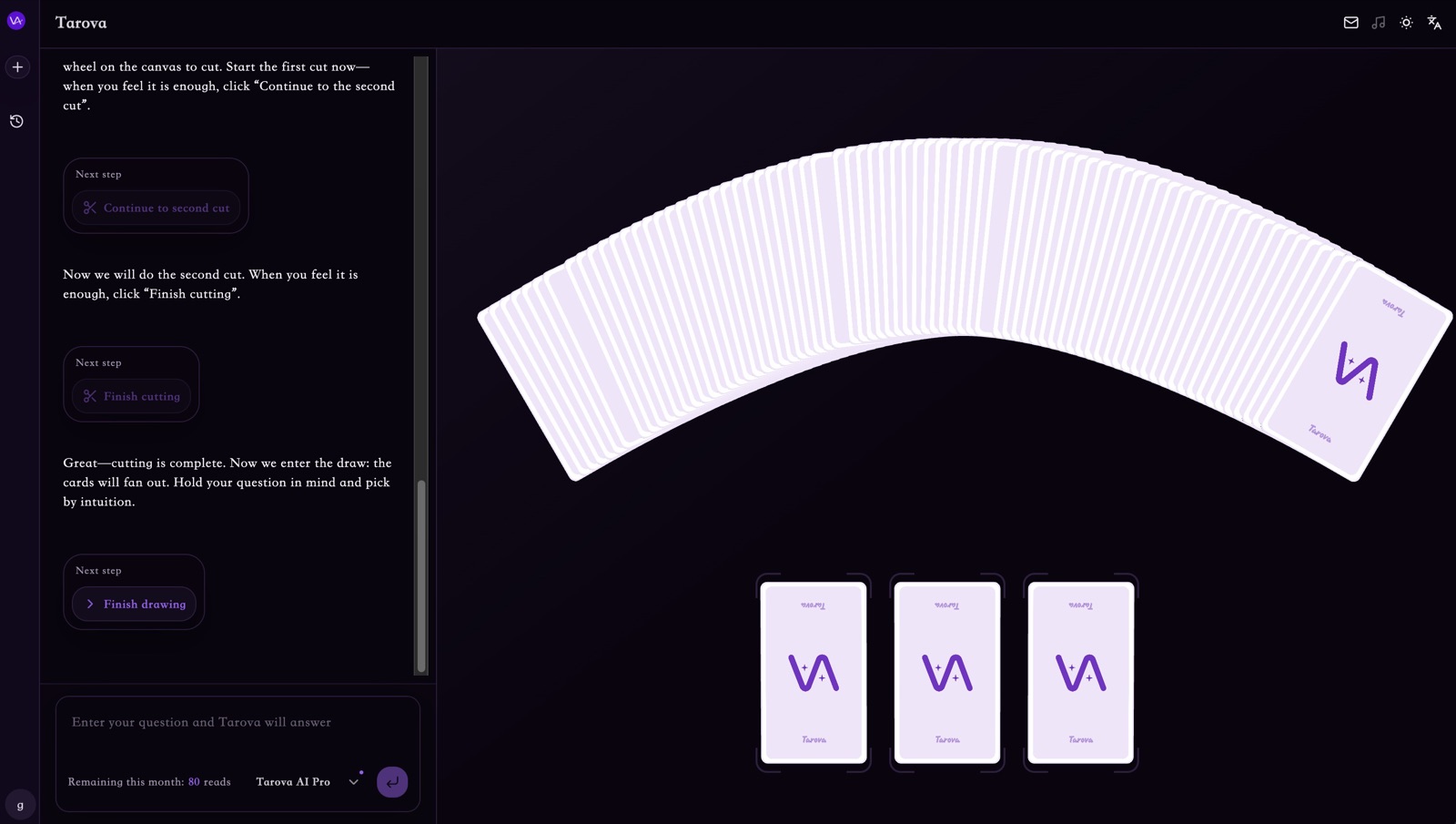
At Tarova.ai, the goal is different. The experience is built around guided questioning plus realistic shuffle, cut, and draw interactions so users can move from a blurry emotional state toward a clearer question before interpretation begins. That matters because a clearer question usually leads to a more reliable answer.
Tarova is not designed around "instant random card, instant dramatic verdict." It is designed to help users:
- clarify what they are actually asking
- move through a more immersive and intentional reading flow
- receive a structured interpretation
- leave with a practical next step rather than vague symbolism
That approach is especially useful for high-frequency yes or no themes such as relationship decisions, career choices, personal boundaries, and self-reflection during uncertainty. If you want to experience that kind of reading flow directly, start with Tarova Chat, then explore real-world examples in Showcases.
How to Handle a Yes, No, or Maybe Answer
The answer is only useful if you know what to do with it.
If the answer is yes
A yes usually suggests support, alignment, or open momentum. That does not always mean "this will be easy." It usually means the path is viable if you act with awareness.
Ask yourself:
- What is the next concrete action?
- What would I need to do to support this outcome?
- Am I ready to move instead of only hoping?
If the answer is no
A no does not always mean failure forever. Often it means:
- not on this path
- not under these conditions
- not right now
A strong no can be protective. It can stop you from forcing something that is misaligned.
If the answer is maybe
This is where people get frustrated, but maybe answers are often the most accurate ones.
A maybe can mean:
- there is missing information
- your question needs refinement
- timing is not mature yet
- the situation depends on a choice not made yet
Instead of redrawing immediately, ask:
- What is still unclear?
- What condition needs to change?
- What am I trying to force into certainty too early?

Signs a Yes or No Tarot Reading Is Actually Reliable
You can usually trust a reading more when these signs are present:
- The question was specific and honest.
- The answer fits the emotional truth of the situation, even if it is uncomfortable.
- The interpretation explains why the answer is yes, no, or maybe.
- The result gives direction, not just suspense.
- You feel clearer after the reading, not more addicted to asking again.
A reliable reading does not always make you feel better immediately. Often it makes you feel more grounded, more precise, and more capable of acting.
A Simple Accuracy Checklist
Before doing your next reading, run through this short checklist:
- Am I asking one question or five hidden questions?
- Is this question really about my decision?
- Am I willing to hear "not yet"?
- Will I accept the first answer?
- Do I want clarity, or do I want reassurance?
If you can answer those honestly, your reading is far more likely to be useful.
Frequently Asked Questions
Can tarot answer yes or no questions?
Yes. Tarot can answer yes or no questions when the question is specific and the interpretation respects context. The strongest yes or no readings are focused on one decision, one action, or one clear direction.
Is yes or no tarot accurate for love?
It can be, especially when the question is about your own action or alignment. Questions like "Should I reach out?" or "Is this relationship healthy for me right now?" are usually more reliable than trying to read someone else's private feelings with total certainty.
How many times can you ask the same question in tarot?
Ideally once in the same emotional cycle. Repeating the same question over and over usually reduces clarity and increases projection. If the answer is hard to accept, it is better to reflect on it than to keep redrawing.
Why do I get a maybe answer?
A maybe answer usually means the situation is still developing, key information is missing, or the question is not specific enough yet. It is often a sign to pause, refine the question, and look at timing.
Is online yes no tarot accurate?
It can be, but only when the tool helps you clarify the question and interpret the answer thoughtfully. A guided, immersive reading flow is usually more reliable than a random instant answer with no context.
Final Thoughts
So, is yes or no tarot accurate?
Yes, it can be very accurate when it is used the right way. The real key is not whether the format is simple. The key is whether the question is clear, the reading process is intentional, and the answer is interpreted with context rather than forced into a shallow binary.
If you want a fast answer without clarity, any reading can feel random. But if you want a more reliable yes or no reading, start by asking a better question and using a process that helps you slow down, focus, and reflect honestly.
If you want to experience that kind of reading flow, Tarova.ai is built for exactly that. You can begin with the immersive reading experience in Chat, explore how different real-life scenarios unfold in Showcases, and follow through when you are ready in Pricing.
The best yes or no tarot reading is not the one that gives you the fastest answer. It is the one that helps you make the clearest next decision.