If you searched 10 card tarot reading, you are probably looking for something deeper than a quick yes-or-no answer. A larger spread usually attracts people when the situation feels layered, emotionally loaded, or too complex for a one-card or three-card pull.
That instinct makes sense. A 10 card tarot reading can reveal more context, more tension, and more structure than a smaller layout. But it can also create a new problem: too many symbols at once, too many interpretations, and not enough actual clarity.
That is the real challenge of a bigger spread. The goal is not to collect more cards. The goal is to understand a situation in a way that helps you think, feel, and act more honestly.
In this guide, we will break down what a 10 card tarot reading is really for, when it helps, how the positions usually work, and how to read a bigger spread without spiraling into over-interpretation.
What a 10 card tarot reading is really for
A 10-card spread is not automatically "better" than a smaller reading. It is better only when the question actually has enough moving parts to justify the extra structure.
A 10 card tarot reading is most useful when:
- the issue has both inner and outer layers
- you need to understand a pattern, not just get a quick theme
- multiple influences are shaping the situation at once
- you want to see tension, support, fear, and direction in one reading
This is why ten-card layouts are often associated with the Celtic Cross or similar structured spreads. They are designed for situations where one simple answer is not enough.
Good examples include:
- a relationship that feels meaningful but inconsistent
- a career decision with emotional, practical, and timing factors
- a repeating life pattern that keeps resurfacing in different forms
- a moment when you feel pulled in two directions and cannot tell what matters most
What a 10-card spread does well is give each part of the situation a place. That structure matters. Without clear positions, ten cards can become noise instead of insight.
If you are still deciding whether a large spread is even necessary, start with How to Choose the Right Tarot Spread for Your Question. Sometimes the best reading is the smallest one that can do the job.
When to use a 10 card spread and when not to
People often reach for a larger reading when they feel emotionally flooded. Ironically, that is not always the best time to use one.
Use a 10 card tarot reading when:
- you are grounded enough to track multiple positions
- the question is specific, even if the situation is complex
- you want pattern recognition more than reassurance
- you are willing to sit with nuance instead of forcing a fast answer
Avoid it, or at least pause before using it, when:
- you are asking the same question repeatedly
- you secretly want the spread to remove responsibility for a decision
- you are so anxious that ten cards will only multiply your fear
- the question is narrow enough that one to three cards would already be enough
This is one reason beginners sometimes struggle with large spreads. The issue is not intelligence. It is emotional bandwidth. A big layout asks you to hold several symbolic threads at once and still remember the original question.
That is why a 10 card tarot reading works best when the reader has a clear intention and a clear stopping rule. You are not opening the spread to extract infinite certainty. You are opening it to understand the shape of the situation.
A practical way to understand the 10 positions
Different readers use slightly different ten-card layouts, but most 10 card tarot reading structures are trying to map a situation across a few core dimensions:
- What is happening right now
- What is crossing or complicating it
- What is underneath the situation
- What is visible or conscious
- What is fading or already behind you
- What may be developing next
- How you are relating to the situation
- How other people or outer conditions affect it
- What fear or hope is shaping your view
- Where the current path seems to lead
You do not need to memorize these word for word to read well. What matters is understanding what each position is trying to do.

Here is the deeper logic:
- early positions describe the core situation
- middle positions show hidden dynamics and movement
- later positions reveal perspective, environment, and likely direction
That is why ten-card spreads can be so useful. Instead of asking one card to do everything, the layout distributes meaning across separate jobs.
This also explains why position matters so much. The same card can mean something very different depending on where it lands. The Hermit in an advice position is not the same as the Hermit in a fear position. The Tower in a future position is not the same as the Tower describing what is already ending.
If you want a broader foundation before going deeper into large layouts, our guide to tarot spreads explains why card positions change interpretation so dramatically.
How to read a 10 card tarot spread without getting overwhelmed
The biggest mistake in a 10 card tarot reading is trying to interpret all ten cards with equal intensity at the same time.
A better approach is to read in layers.
Start with the backbone
Before you analyze every detail, identify the structural backbone of the reading:
- what is the central situation?
- what is crossing it?
- what energy seems to be moving next?
- what outcome or direction appears at the end?
This gives you a first draft of the story.
Then look for repeating themes
Once the backbone is visible, ask:
- Are several cards pointing to the same emotional truth?
- Do the cards lean toward motion, pause, conflict, healing, confusion, or release?
- Are you seeing a pattern of fear, avoidance, clarity, grief, pressure, or hope?
You are not trying to flatten the spread into a slogan. You are trying to notice what repeats.
Let the positions control the reading
One reason big spreads become chaotic is that readers start free-associating too early. If a card lands in a hope or fear position, respect that job. Do not immediately read it as fate. If a card lands in an environment position, do not assume it defines your inner truth.
The spread is there to hold boundaries. Let it.
Do not pull clarifiers too fast
Many people ruin a good 10 card tarot reading by adding more cards the moment something feels uncomfortable. Usually the problem is not lack of information. It is discomfort with ambiguity.

Before pulling extra cards, ask:
- Did I actually understand the question?
- Am I skipping the position I least want to look at?
- Is the reading complicated, or am I resisting what it already says?
If the spread still feels muddy, the issue may be the question rather than the cards. How to Ask a Tarot Question for a Clearer Reading can help you reset before you read again.
What kinds of questions work best in a 10 card tarot reading
A large spread works best when the question invites depth without becoming shapeless.
Stronger questions sound like:
- What do I most need to understand about this relationship pattern?
- What is really shaping my hesitation around this career change?
- What dynamics am I missing in this conflict?
- What is unfolding here, and how should I relate to it wisely?
Weaker questions sound like:
- Is this good or bad?
- Tell me everything
- What will happen exactly and when?
- Should I keep asking until I feel better?
The difference is simple: a strong question gives the spread a job. A weak question makes the spread carry emotional chaos with no container.

That is one reason a 10 card tarot reading can be incredibly useful for self-reflection, but not very helpful for emotional compulsions. The larger the spread, the more important the framing becomes.
Common mistakes with a 10 card tarot reading
Most problems with large spreads are not about the cards themselves. They are about how the reading is approached.
Using a big spread to chase certainty
Ten cards do not guarantee truth. They guarantee more material. If you are hoping a larger spread will erase uncertainty completely, you will usually end up more attached to interpretation, not less.
Ignoring the emotional state of the reader
If you are exhausted, panicked, or looping, a ten-card spread can amplify projection. In that state, a smaller reading is often wiser.
Reading every card in isolation
A 10 card tarot reading is a system. The value comes from relationships between positions, not from treating each card like a standalone prophecy.
Forgetting the question halfway through
This happens more than people realize. A reading starts with one real issue and slowly drifts into symbolic sightseeing. Keep the original question visible while you read.
Confusing the likely outcome with fixed destiny
Most tenth-position style outcome cards describe where the present pattern is heading, not what must happen forever. Tarot is far more useful when read as dynamic guidance rather than a rigid sentence.
Why a guided tarot experience can help with large spreads
A 10 card tarot reading is one place where structured interpretation matters more than ever. The bigger the spread, the easier it is to lose the thread.
This is where guided tarot tools can genuinely help, especially when they do more than list card meanings.
A better reading experience should help you:
- clarify the real question before drawing
- move through the shuffle and draw process with intention
- keep card positions anchored to their actual role
- identify repeating themes across the spread
- turn the reading into one practical takeaway instead of ten disconnected meanings
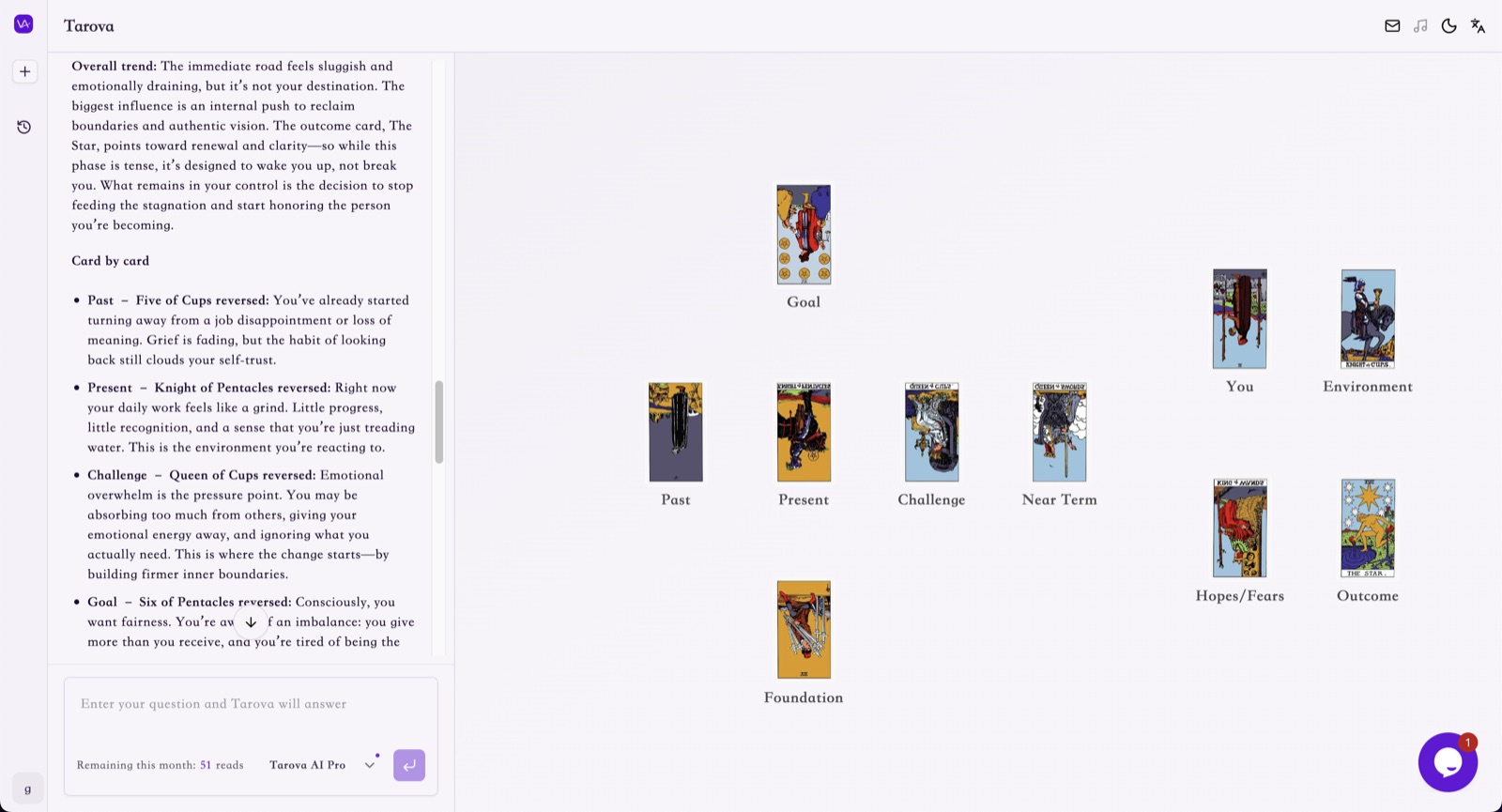
At Tarova, this is exactly the gap we care about. Our reading flow is built around question clarity, immersive ritual, structured card interpretation, and follow-up conversation. Instead of treating a big spread like ten isolated definitions, we help users see the emotional pattern, the turning point, and the next step more clearly. If you want that kind of experience, you can start with Tarova chat, explore reading examples in showcases, or see the full path at pricing.
Conclusion
A 10 card tarot reading can be powerful, but only when the spread has a real reason to be that large. Used well, it gives complex situations enough structure to reveal what is happening underneath the surface. Used badly, it becomes a pile of symbols that creates more anxiety than insight.
The difference usually comes down to three things:
- the quality of the question
- the clarity of the positions
- the reader's ability to interpret the spread as a whole
So if you feel drawn to a ten-card layout, do not ask whether it looks impressive. Ask whether your situation actually needs that much structure.
When the answer is yes, a bigger spread can do something a smaller one cannot: it can hold contradiction, context, fear, movement, and possibility in the same reading without collapsing them into one flat answer.
FAQ
What is a 10 card tarot reading used for?
A 10 card tarot reading is usually used for more complex questions where multiple influences are involved. It helps explore the current situation, hidden factors, outer conditions, personal perspective, and likely direction in one structured layout.
Is a 10 card tarot reading the same as a Celtic Cross?
Not always, but many people use the phrase 10 card tarot reading to mean a Celtic Cross or a very similar spread. The exact positions can vary slightly, but the purpose is usually the same: deeper context and more structure.
Is a 10 card tarot reading good for beginners?
It can be challenging for beginners. A large spread asks you to track more positions and hold more symbolic information at once. Many readers learn faster by starting with one-card or three-card spreads before moving into ten-card layouts.
How do I interpret a 10 card tarot spread without getting confused?
Start with the core positions first, then look for repeating themes, and let the position of each card control the interpretation. Do not try to read all ten cards with equal intensity at once, and avoid pulling extra clarifiers too quickly.
Can a 10 card tarot reading predict the future?
It can suggest where the current pattern is likely heading, but it is more useful as a tool for reflection and guidance than as a rigid prediction machine. Large spreads work best when they help you understand the situation and your role in it more clearly.