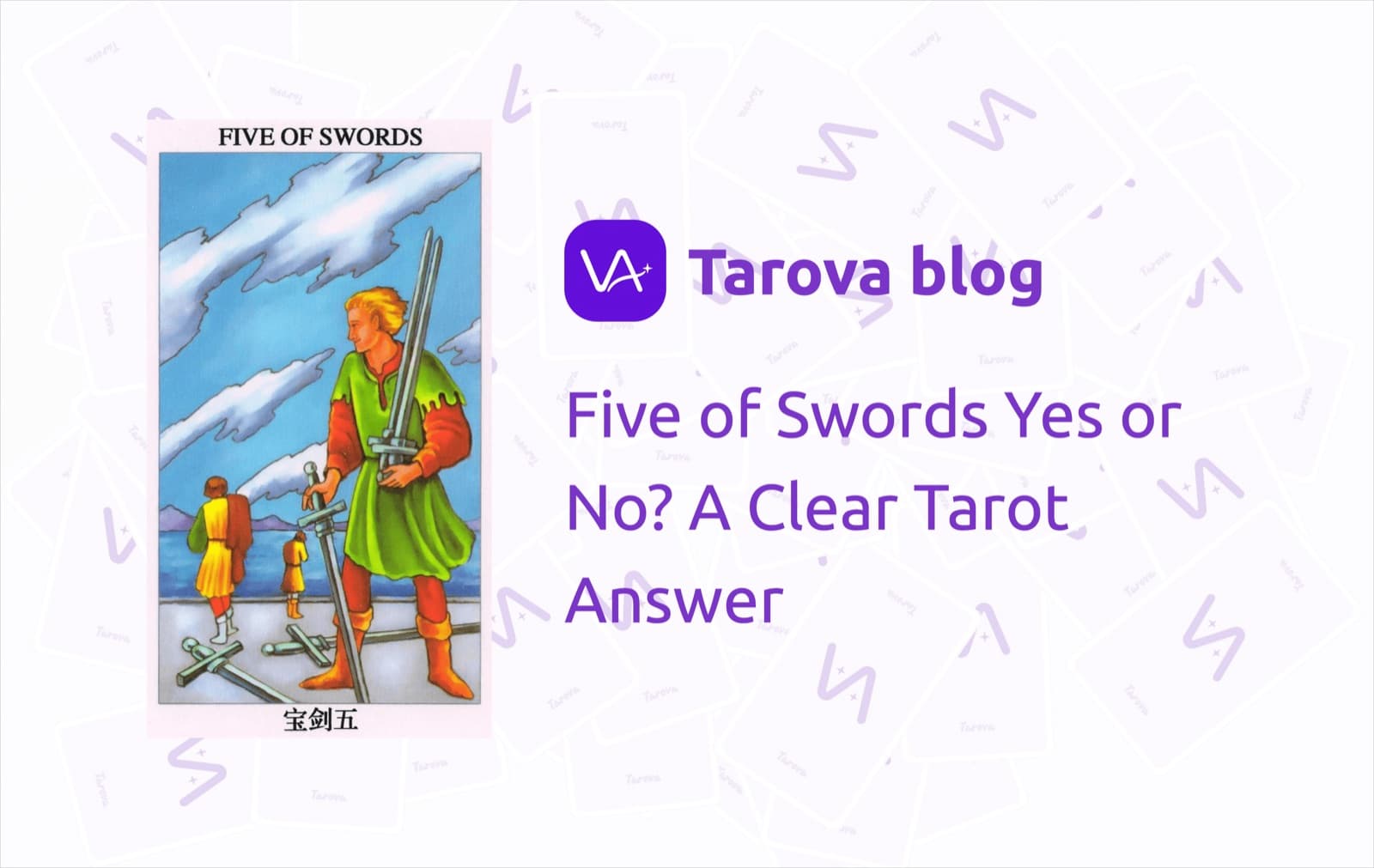
If you searched five of swords yes or no, you probably want the shortest possible answer first. In most tarot readings, the Five of Swords is a NO. It is one of the clearer no cards in the deck, especially when the situation is shaped by conflict, ego, mixed motives, or a win that costs too much.
This card does not usually point to peaceful progress. It points to tension. Someone may be pushing too hard, reacting from pride, refusing to listen, or trying to force an outcome that leaves everyone worse off. In yes-or-no tarot, that usually makes the answer negative.
Still, the Five of Swords is not only about defeat. It is also about awareness. Sometimes the card appears so you can stop a destructive pattern before it goes further. That means its no can actually be protective. It may be telling you that the current path creates more damage than value.
So if you pulled this card and asked about a relationship, confrontation, decision, or whether something will work out as planned, think of it this way:
Five of Swords = No, especially when ego, conflict, or unhealthy power dynamics are part of the situation.
Five of Swords yes or no: quick verdict
Here is the direct version:
- Upright Five of Swords: No
- Reversed Five of Swords: Maybe, if conflict is being released or repaired
Why does this card usually lean no? Because it is strongly tied to:
- conflict
- defeat
- hostility
- broken trust
- ego clashes
- stressful fallout
This is not the kind of card that says everything is aligned. It often appears when the emotional cost of the situation is too high, or when the way someone is trying to get the result is already damaging the connection, the team, or their own peace.
That is why the upright card usually means no. It does not suggest a clean yes. It suggests that even if someone technically "wins," the situation may still feel hollow, tense, or unsustainable.
Core meaning of the Five of Swords
At its core, the Five of Swords is about conflict that leaves a mark. It can show arguments, misunderstandings, power struggles, or situations where one person wants to be right more than they want resolution.
The card can suggest:
- tension that is wearing everyone down
- a victory that comes with regret
- resentment or defensiveness
- poor communication
- walking away from an unhealthy dynamic
This is why the card often feels sharp. It is not subtle about emotional friction. But it also carries an important lesson: not every battle deserves to be continued.
In yes-or-no tarot, that often becomes a no because the card recognizes when the energy around the question is already too distorted. The problem is not just what you want. The problem is the cost of how it is being pursued.
Upright meaning of the Five of Swords
Upright, the Five of Swords usually shows a situation where conflict is active, unresolved, or likely to escalate. It can suggest that someone is acting defensively, unfairly, or from a place of insecurity disguised as control.
In real life, the upright card may indicate:
- arguments that go nowhere
- emotional or professional tension
- mixed motives
- a painful disagreement
- the need to step back before more damage happens
This is why the upright card so often means no. It does not support harmony. It does not support clean trust. If your reading asks whether something can move forward well under current conditions, the upright card often says:
No, not while this conflict is driving the situation.
That does not always mean permanent failure. It may mean that peace, honesty, or perspective have to return before any real yes becomes possible.
Reversed meaning of the Five of Swords
Reversed, the Five of Swords can soften. It may suggest that conflict is beginning to calm down, that someone is ready to make peace, or that the question is shifting from "how do I win?" to "what is actually worth saving?"
You may be dealing with:
- choosing peace over pride
- a conflict losing intensity
- willingness to apologize or disengage
- emotional exhaustion with drama
- learning from a painful pattern
In a yes-or-no reading, the reversed card often means:
- maybe
- yes, if the conflict is genuinely being resolved
- not until pride is put aside
That nuance matters. Reversed Five of Swords is not automatically cheerful, but it can show the beginning of repair. The card becomes less about conquest and more about release.
If your question keeps circling the same conflict, it may help to stop asking for a verdict and ask for clarity instead. How to Ask a Tarot Question for a Clearer Reading and Is Yes or No Tarot Accurate? can help you reset your approach.
Five of Swords yes or no in love
In love readings, five of swords yes or no usually means no when the relationship is shaped by arguments, manipulation, emotional games, defensiveness, or unresolved hurt.
This card can point to:
- repeated fights without repair
- power struggles
- one person trying to win instead of understand
- emotional distance caused by conflict
- pain that keeps getting reopened
If you asked, "Should I reach out?"
Usually no, at least not in the same energy that created the problem. The card suggests that contact may deepen tension unless something has genuinely shifted.
If you asked, "Can this relationship recover?"
Possibly, but not as a quick yes. The answer is more like maybe, if both people stop treating the relationship like a battleground.
If you asked about reconciliation
The card usually leans no in the short term. Reconciliation may be possible later, but not if the same pride, blame, or emotional warfare is still active.
If you asked, "Is this healthy for me?"
Often no. The Five of Swords can be a strong sign that the connection is draining more than it is giving.
If you want more relationship-focused support, the love category is a good next step.
Five of Swords yes or no in career
In career readings, five of swords yes or no usually means no when the workplace is driven by politics, competition without trust, or tension that makes success feel exhausting rather than meaningful.
This card can suggest:
- a hostile work environment
- office politics
- someone acting from ego
- a project being undermined by conflict
- stress that is no longer worth the result
If you asked, "Should I accept this offer?"
Usually no if the environment already feels combative, manipulative, or unclear.
If you asked, "Will this conflict at work end well?"
Not under the current conditions. The card often says no, or at least not without serious de-escalation.
If you asked, "Should I keep fighting for this?"
Often no. The Five of Swords asks whether the battle itself is draining too much from you.
If your career question is bigger than a binary answer, What to Ask Tarot When You Feel Lost in Your Career can help you find a more useful next question.
Advice from the Five of Swords
The advice of the Five of Swords is sharp but necessary:
- stop feeding the conflict
- notice where ego is replacing honesty
- ask whether being right is costing too much
- protect your peace
- walk away when the dynamic is no longer constructive
If this card appeared after a yes-or-no question, ask yourself:
- Am I trying to solve this, or win it?
- What is the emotional cost of staying in this dynamic?
- Would stepping back create more clarity than pushing harder?
That is often where tarot becomes genuinely useful. Some readings do not just tell you what is possible. They show what is unhealthy. At Tarova, we treat that seriously. Our reading flow helps users slow down, refine the real question, move through an immersive shuffle and draw, and receive a structured interpretation with practical next steps. If that sounds more useful than chasing a flat answer, start with Tarova chat, explore real reading paths in showcases, or see the deeper experience at pricing.
When the Five of Swords is a yes, a no, or a "maybe if it changes"
This card becomes clearer when you match the answer to the type of question you asked.
| Your question | Likely answer | Why |
|---|---|---|
| "Will this go smoothly under current conditions?" | No | Conflict and tension are already shaping the outcome. |
| "Should I keep pushing this argument?" | No | The card warns that the emotional cost is too high. |
| "Is this relationship healthy right now?" | No | Ego clashes, hurt, or repeated conflict may be too active. |
| "Can this improve if both sides drop the fight?" | Maybe | Reversed or softened energy can point to repair. |
| "Should I choose peace over proving a point?" | Yes | The deeper lesson of the card is often release, not conquest. |
If the answer feels harsh, remember that the card is not only rejecting the outcome. It may be rejecting the pattern. The Five of Swords often says:
No, because this path is costing too much.
FAQ
Is Five of Swords a yes or no card?
Usually it is a no card. The Five of Swords often points to conflict, ego clashes, stressful outcomes, and situations where the emotional cost is too high.
What does five of swords yes or no mean in love?
In love, the card often means no when the relationship is filled with arguments, blame, power struggles, or emotional exhaustion.
Does reversed Five of Swords mean yes?
Sometimes it can mean maybe or yes, if peace is being restored. Reversed, the card may suggest that conflict is easing or that someone is choosing repair over pride.
Is Five of Swords a bad sign for work?
Often yes. In work readings, it can point to office politics, hostility, poor communication, and success that does not feel worth the stress.
Can Five of Swords be a warning to walk away?
Absolutely. One of its clearest lessons is that not every fight deserves your energy, especially when staying only deepens the damage.
Conclusion
If you came here asking five of swords yes or no, the clearest short answer is this: no, especially when the situation is being driven by conflict, pride, mistrust, or emotional fallout.
The Five of Swords is one of tarot's sharper warning cards. In love, it often shows relationships that are draining, defensive, or locked in unhealthy dynamics. In career, it can point to toxic competition, office politics, and battles that cost too much. Reversed, it leaves room for peace, but only if the fight itself is being released.
So if the card feels unpleasant, do not dismiss it. Its message may be exactly what protects you. The Five of Swords does not just ask whether something can be won. It asks whether winning this way would actually be worth it.